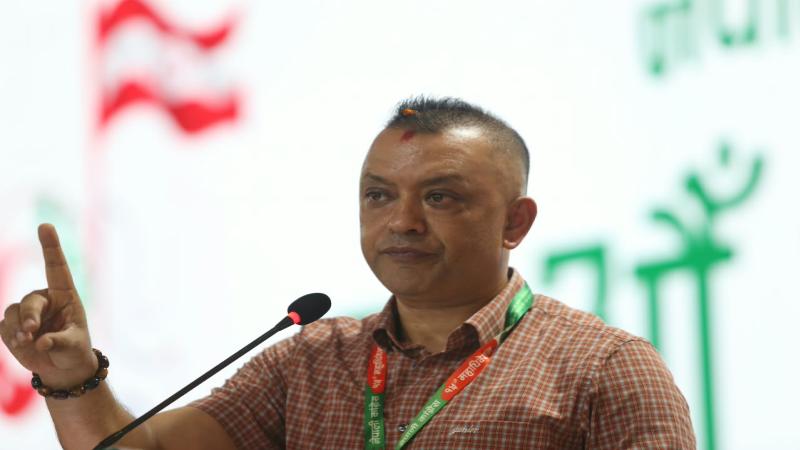
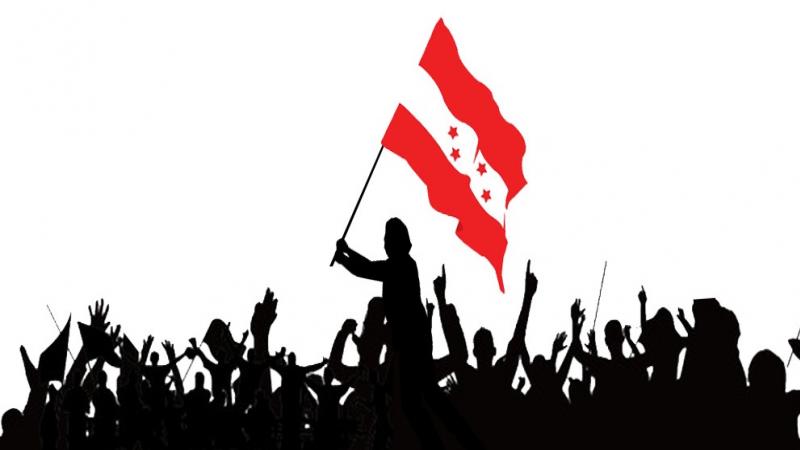
Oct 10, Kathmandu - Gagan Kumar Thapa has been elected as the Chairman of the Nepali Congress. In the vote counting held this morning under the 15th General Convention of the Nepali Congress on Friday, candidate Thapa won by securing 6,584 votes, informed Election Coordinator Prem Bahadur Khadka.
Chairman Thapa's rival Shyam Krishna Khadgi received 375 votes in the election. Out of 7,133 votes cast in the election, 54 votes were invalid. Thapa, who participated in the movement while studying in grade 9 during the 2046 BS People's Movement, has reached the leadership of the Nepali Congress after almost four decades.
The newly elected Chair Thapa began his political journey as a member of the Children's Congress in 2046 BS. He became the secretary of the Nepal Students' Union (Nebisungh), Kathmandu Ward No. 33 in 2048 BS. He was elected as a member of the Independent Students' Union of Trichandra Campus in 2051 BS, secretary in 2053 BS, and president in 2055 BS.
Thapa, who became a member of the Senate of Tribhuvan University in 2055, took student politics to the next level by becoming the Central Vice-Chairman of the Nepali Students' Union in 2057 BS and the General Secretary in 2059 BS. Thapa, who led the movement against the direct rule of the king in 2061 BS, was also charged with treason.
The international human rights organization Amnesty International had declared him a 'prisoner of faith'. He became more famous in national politics after playing an active role in favor of republic and democracy in the 2062/63 BS people's movement.
Thapa, who became a member of the Constituent Assembly from the proportional representation side in the 2064 BS Constituent Assembly election, was active on issues including constitution-making, fundamental rights, child rights, citizenship and energy security. After being elected from Kathmandu Constituency No. 4 in 2070 BS, he contributed to the constitution drafting process. In 2071 BS, he played a role in policy debates related to agriculture, energy and water resources by becoming the chairman of the Agriculture and Water Resources Committee.
Thapa, who became the Minister of Health in 2073 BS, had prioritized issues of health service reform, health insurance and medical education reform during his nine-month tenure. After being elected to the House of Representatives from Kathmandu Constituency No. 4 in the 2074 BS and 2079 BS elections, he had been raising issues of education, health, employment, environment and good governance in the parliament.
Thapa, who was elected as the General Secretary at the 14th General Convention of the Nepali Congress held in 2078 BS, had been working for policy debates and organizational reforms within the party. After the 'Gen-Z' movement held on Bhadra 23 and 24, 2082 BS, Thapa, who called for a special general convention together with another general secretary of the party, Bishwa Prakash Sharma, said that youth participation should be taken forward within the party, was unanimously elected as the party president after the special general convention.
President Thapa, who took over the leadership of the party from the special general convention, was re-elected as the president after nine months at the party's 15th general convention. Along with politics, he is also involved in teaching, media and social campaigns and has been advocating for reforms in education and public services since his student days.
Thapa has been promoting opportunities for youth at home, investment in public education, equal access to health services and good governance as the main agendas of his political journey. His journey from student politics to national leadership is being viewed in connection with the future direction of the Nepali Congress, organizational reforms and political participation of the new generation.





 Indian Rupee
 U.S. Dollar
 European Euro
 UK Pound Sterling
 Swiss Franc
 Australian Dollar
 Canadian Dollar
 Singapore Dollar
 Japanese Yen
 Chinese Yuan
 Saudi Arabian Riyal
 Qatari Riyal
 Thai Baht
 UAE Dirham
 Malaysian Ringgit
 South Korean Won
 Swedish Kroner
 Danish Kroner
 Hong Kong Dollar
 Kuwaity Dinar
 Bahrain Dinar