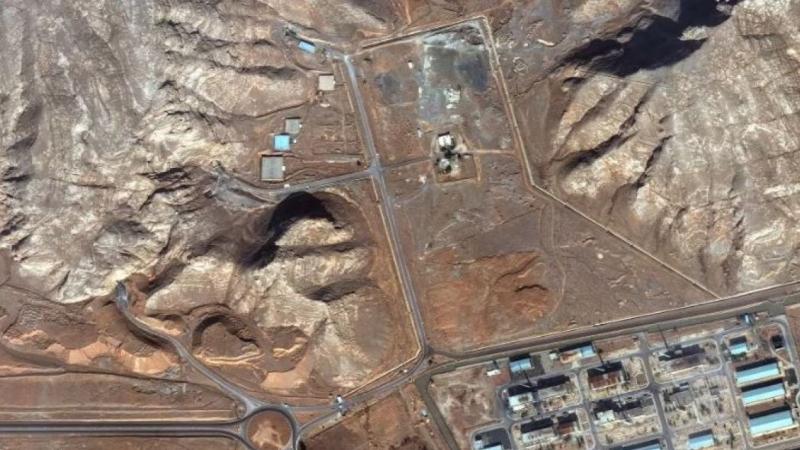
Jun 13, Kathmandu - Iran has taken dramatic steps in recent weeks to secure its stockpile of enriched uranium, which is close to bomb-grade, according to U.S. intelligence sources. Iran has reportedly deliberately destroyed tunnels and planted explosive landmines at entrances.
The sources say it is now more difficult, dangerous and time-consuming to access the nearly half-ton stockpile of highly enriched uranium than it was a month ago, when U.S. President Donald Trump publicly signaled he might order the U.S. military to seize the material.
The new security structure Iran has built has complicated U.S. negotiations with Tehran.
The proposed deal would require Iran to remove and destroy its uranium, but more questions have been raised about who would remove it and how. Iran’s mission to the United Nations did not immediately respond to requests for comment, and the White House did not respond to questions.
Trump has repeatedly said that securing uranium is a top U.S. priority in talks to end the war and reopen the Strait of Hormuz, which Iran has effectively blocked. The U.S. and Iran are close to a deal, a senior U.S. official told reporters on Friday. Under the deal, Iran would hand over its enriched uranium to the United States. It is planned to destroy it on site and then take it out of the country. But U.S. and Iranian officials have been making different claims about the potential deal, and its exact terms have not yet been clear. Trump expressed his anger on social media after a semi-official Iranian news agency published a draft of the deal on Friday.
According to sources, it is now difficult and risky for the Iranians themselves to extract the material. That would require heavy mining equipment and special operations to remove mines, which would be a daunting task. “If this information is true, it will certainly make it more difficult to recover highly enriched uranium,” said Scott Roecker, who served as head of the US National Nuclear Security Administration’s Office of Nuclear Disposal from 2017 to 2021.
He said it could give Iran the ability to demonstrate compliance with its obligations or even hide its actual stockpile. If negotiators agree to bring all of its uranium stockpile to one location, verify and deactivate it, Iran would be responsible for making it available safely. But Roecker worries that Iran could claim some of the uranium is “unrecoverable,” which could leave the hidden material open to future use. The international community believes that most of the uranium is in collapsed tunnels at Iran’s Isfahan nuclear facility, with some also being stored in other locations.
According to a report published by CNN, the US military was preparing for a possible operation to seize the uranium in mid-May, but the plan was abandoned after it was deemed too risky. Since then, Iran has tightened security at sites believed to be holding uranium. Trump has also acknowledged that forcible extraction is risky. In an interview with The Associated Press in May, he expressed skepticism that Iran could extract the material without U.S. intelligence monitoring.
“We know exactly what’s going on there,” he said. “Nobody’s even close to it yet,” he said. But sources say Trump’s public mention of uranium as a potential target may have prompted Iran to tighten security on its nuclear assets. Even if a U.S.-Iran deal is signed next week, detailed technical talks on the future of Iran’s nuclear program are still expected to take place.
The uranium could be transported out of the country using a special mobile uranium processing facility operated by the U.S. National Nuclear Security Administration’s Oak Ridge National Laboratory in Tennessee. U.S. negotiators Jared Kushner and Steve Witkoff visited the facility earlier this month, CNN reported. But it will take even the world's best nuclear materials management experts a considerable amount of time to complete the task. Speaking to reporters earlier this month, Trump said it would take at least two weeks to complete the uranium removal process.








 Indian Rupee
 U.S. Dollar
 European Euro
 UK Pound Sterling
 Swiss Franc
 Australian Dollar
 Canadian Dollar
 Singapore Dollar
 Japanese Yen
 Chinese Yuan
 Saudi Arabian Riyal
 Qatari Riyal
 Thai Baht
 UAE Dirham
 Malaysian Ringgit
 South Korean Won
 Swedish Kroner
 Danish Kroner
 Hong Kong Dollar
 Kuwaity Dinar
 Bahrain Dinar