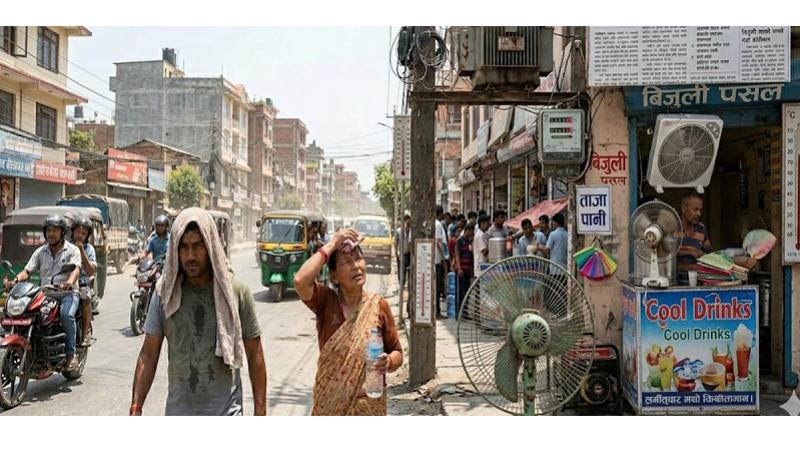
May 22, Kathmandu - India's soaring temperatures have led to a surge in the use of cooling appliances, pushing the country's electricity demand to unprecedented heights. Energy producers are now generating record levels of power to meet the overwhelming demand during this intense heatwave.
According to the Ministry of Power, on Thursday, the country's peak electricity demand reached an all-time high for the fourth consecutive day, peaking at 270.82 gigawatts around 3:45 PM, with supply fully maintained. The capital, New Delhi, experienced temperatures soaring to 45.3°C, marking the highest demand in India's history. The previous record was set on Wednesday at 265.44 gigawatts.
The Ministry highlighted that increased use of air conditioners, coolers, and other cooling devices due to rising temperatures has caused an extraordinary spike in electricity consumption. Currently, about 62% of India's total power generation comes from coal-based thermal plants, with solar energy contributing 22%, wind and hydropower making up 5%, and the remaining from other sources.
Despite the government claiming record power production, many social media users have reported ongoing power outages in various regions. Experts warn that the additional load on old power lines and transformers increases the risk of local blackouts.
India, with a population of over 1.4 billion, usually experiences extreme heat from April to June, but recent years have seen a rise in both temperature intensity and duration. Climate studies attribute these trends to climate change, resulting in longer, more frequent, and more dangerous heatwaves.
The India Meteorological Department reported that on Thursday, the maximum temperature in Banda, Uttar Pradesh, reached 47.6°C. While slightly lower than the week's record of 48.2°C, the region remains extremely hot. The highest official temperature ever recorded in India was 51°C in Firozpur, Rajasthan, in 2016.
Meanwhile, the international air quality monitoring platform IQAir highlighted that India is home to 50 of the world's hottest cities, according to their April report. Daily heat index measurements indicate that Indian cities are experiencing severe heat stress, driven by high temperatures, solar radiation, air quality, humidity, and rainfall.

















 Indian Rupee
 U.S. Dollar
 European Euro
 UK Pound Sterling
 Swiss Franc
 Australian Dollar
 Canadian Dollar
 Singapore Dollar
 Japanese Yen
 Chinese Yuan
 Saudi Arabian Riyal
 Qatari Riyal
 Thai Baht
 UAE Dirham
 Malaysian Ringgit
 South Korean Won
 Swedish Kroner
 Danish Kroner
 Hong Kong Dollar
 Kuwaity Dinar
 Bahrain Dinar