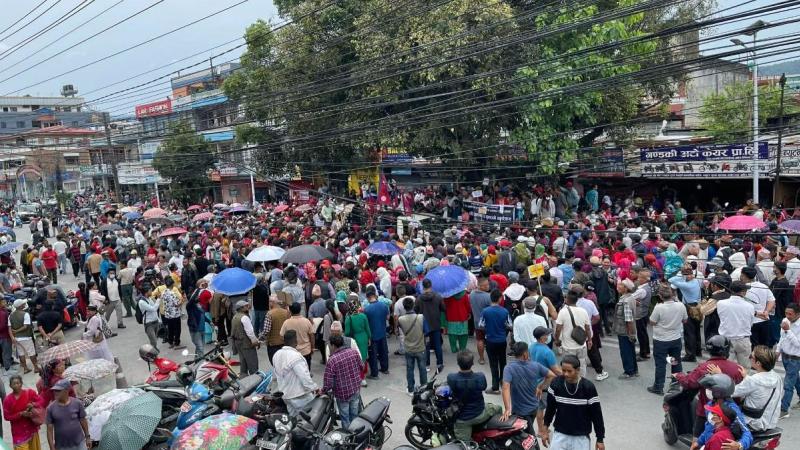
May 04, Kathmandu - Frustrated by what they call unjustified demolitions, slum dwellers in Pokhara have launched protests after government bulldozers operated in Kathmandu’s informal settlements, sparking nationwide outrage.
The residents allege that authorities used excessive force and bulldozers without proper arrangements, prompting residents from Pokhara to take to the streets in protest. They vow to continue their agitation until their demands are heard.
In response, the Pokhara Metropolitan City issued a notice on Baisakh 4 giving residents and organizations residing on government and public land, including areas like Prithvi Chowk, 35 days to vacate. The protest leaders have condemned this move, claiming it spreads fear and insecurity among slum communities across the country.
Following a rally and public gathering, Arjun Karki, advisor to the Kaski-based Landless and Informal Settler Struggle Committee, sharply criticized the government for safeguarding refugee groups like Bhutanese and Tibetans while neglecting its own citizens.
He warned that before demolishing slum settlements, the government should revoke citizenship certificates if it refuses to protect its own people. “The country protects refugees but ignores its own slum dwellers—either safeguard our rights or revoke our citizenship,” Karki declared.
According to Karki, Nepal has deployed around 5,000 security personnel—including 3,000 police, 2,000 armed forces, and 1,000 municipal police—to demolish around 250 homes in Kathmandu’s slum areas, fueling fears and spreading false rumors that residents are leaving voluntarily.
He also accused mainstream political parties, including the Rastriya Swatantra Party, of luring and deceiving slum residents to garner votes. Karki claimed old parties failed to address the issue and only used the problem as a vote bank, promising new management that remains unfulfilled.
“We were deceived into voting with false promises; now, with bulldozers arriving within two months, we want our votes back,” Karki demanded.
The protesting slum leaders have submitted a memorandum to the Chief District Officer of Kaski, Rudra Devi Sharma, and the Chief Administrative Officer of Pokhara Metropolitan City, urging the government to respect constitutional rights to housing, land, and livelihood.
They insist that the government must ensure proper management of slum settlements before any eviction is carried out.
The land in question was acquired in 2032 B.S. (1975 A.D.) for a bus park project by the Pokhara Sub-Metropolitan City Development Committee. Currently, around 475 households reside there, many with water and electricity connections made with the committee’s approval, contrary to claims of illegal encroachment.
Karki emphasized that they are not encroachers but residents who have obtained official documents, including slum identification papers issued in 2068 B.S. and again in 2077/78 B.S. He urged authorities not to misconstrue their settlement as illegal.
“We are not encroachers; we connected water and electricity with the city’s approval,” Karki clarified. “Any claims of illegal occupation are false.”
As tensions rise, the government faces mounting pressure to address the concerns of Nepal’s marginalized communities and ensure their rights are protected amid ongoing eviction threats.









 Indian Rupee
 U.S. Dollar
 European Euro
 UK Pound Sterling
 Swiss Franc
 Australian Dollar
 Canadian Dollar
 Singapore Dollar
 Japanese Yen
 Chinese Yuan
 Saudi Arabian Riyal
 Qatari Riyal
 Thai Baht
 UAE Dirham
 Malaysian Ringgit
 South Korean Won
 Swedish Kroner
 Danish Kroner
 Hong Kong Dollar
 Kuwaity Dinar
 Bahrain Dinar