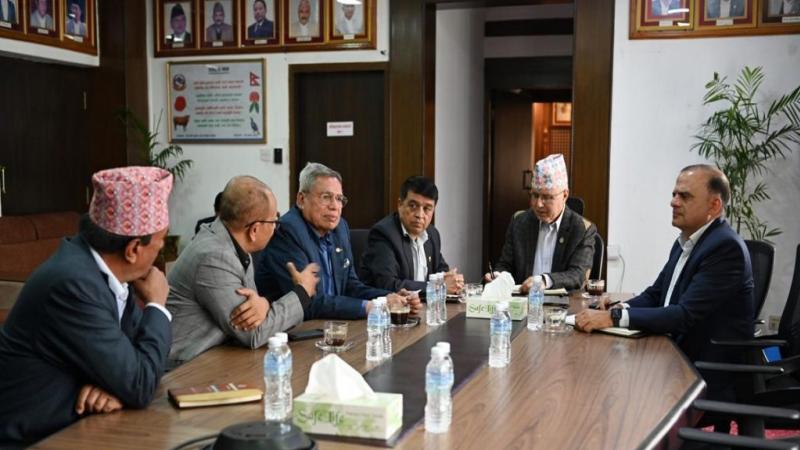
Mar 12, Kathmandu - Nepal’s Finance Minister Rameshwar Prasad Kandel engaged in a constructive discussion with representatives of the private sector to address current economic challenges and explore avenues for growth. The meeting, held today at the Ministry of Finance, saw the participation of key industry leaders, including Chandra Prasad Dhakal, President of the Nepal Chamber of Commerce; Kamlesh Kumar Agrawal, President of the Nepal Chamber of Commerce Federation; Virendra Raj Pande, President of the Nepal Industries Council, and Khemraj Bhandari, President of the Nepal Industry and Trade Federation.
Minister Kandel expressed his gratitude for the support and cooperation received from the private sector during his tenure. He acknowledged that restoring confidence and improving the business environment after the disruptions caused by protests on Bhadra 23 and 24 of 2082 BS was an initial challenge. However, he noted that collaborative efforts have begun to yield positive results, leading to an improved economic climate.
According to Finance Ministry spokesperson Tanka Prasad Pandey, the discussion focused on maintaining macroeconomic stability, creating a business-friendly environment, protecting domestic industries, promoting exports, ensuring transparency in the capital market, and establishing good governance in the economy.
Minister Kandel informed the participants that some issues raised during the consultation had already been addressed based on the suggestions received. He added that due to existing policy complexities, some remaining tasks would be handed over to the next economic leadership for continuation.
During the meeting, private sector representatives appreciated Minister Kandel’s keen interest in resolving private sector issues. They emphasized that political stability is crucial for the country’s development and expressed positive expectations following the recent elections.
The private sector also highlighted several policy recommendations, including the implementation of a multi-rate VAT system, minimizing the import duty gap between raw materials and finished goods, boosting export promotion, assessing the effectiveness of regulatory agencies, and reducing high inter-tax rates to foster economic growth.















 Indian Rupee
 U.S. Dollar
 European Euro
 UK Pound Sterling
 Swiss Franc
 Australian Dollar
 Canadian Dollar
 Singapore Dollar
 Japanese Yen
 Chinese Yuan
 Saudi Arabian Riyal
 Qatari Riyal
 Thai Baht
 UAE Dirham
 Malaysian Ringgit
 South Korean Won
 Swedish Kroner
 Danish Kroner
 Hong Kong Dollar
 Kuwaity Dinar
 Bahrain Dinar