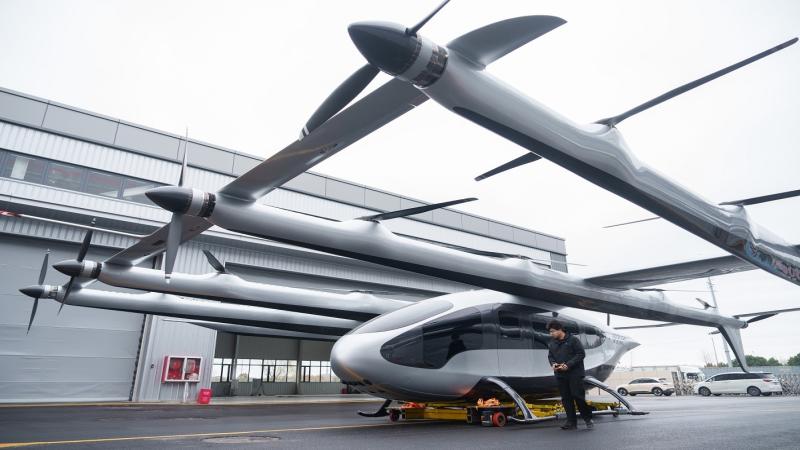
Mar 06, Kathmandu - China's burgeoning development of an advanced electric aircraft, the ‘Matrix,’ hints at a future where aerial taxis could become a common sight in cities. Currently undergoing testing in the southeastern city of Kunshan, this 10-passenger electric aircraft is considered the largest of its kind in China capable of Vertical Takeoff and Landing (VTOL).
Recently showcased at a hanger near the Shanghai port, approximately 60 kilometers west in Kunshan, the ‘Matrix’ resembles a giant drone, weighing around five tons. It signals the possibility of urban air taxi services in the future, promising faster and more efficient city transit.
Developed by Chinese firm AutoFlight, established in 2017, the Matrix can carry up to 10 passengers. Its wingspan spans about 20 meters (roughly 66 feet), with a length of 17.1 meters and a height of 3.3 meters. Fully charged, it boasts an operational flight time of approximately one hour.
AutoFlight demonstrated the aircraft's capabilities during a live flight at their low-altitude flight test center. During the cold-weather test, staff prepared the aircraft from its hanger to the helipad, then initiated the propellers and conducted system checks. After confirming all systems were functioning well, the Matrix ascended smoothly, producing a quieter noise compared to traditional helicopters. The aircraft flew for about 10 minutes, performing two circles around the helipad before safely returning and landing.
While promising, widespread adoption of this technology remains several years away. According to Steven Yang, AutoFlight’s Senior Vice President, it’s still uncertain when flying taxis will operate as regular services. The company has already developed a two-ton capacity VTOL aircraft awaiting certification. They expect to receive a ‘Type Certificate’ from regulators by 2027, which confirms the aircraft’s safety standards. However, operator certifications and other approvals will also be necessary for passenger services.
Currently, the Matrix remains in the prototype phase, with other Chinese companies also developing VTOL aircraft. For instance, Guangdong-based Ehangan has secured certification for their aircraft intended for commercial passenger use, though commercial services have yet to launch.
Experts caution that obtaining permission alone isn’t enough. Infrastructure, flight routes, safety systems, and operational management must all be developed to support urban air mobility.
China has been actively promoting the ‘Low-Altitude Economy’ concept, expanding the use of drones and small flying devices. For example, in Shenzhen, drone-based food delivery services are already operational.
Garry Ang, a senior economist at Natixis Corporate & Investment Banking, emphasizes that the growth of the flying taxi industry involves overcoming significant challenges related to safety, infrastructure, and airspace management. He notes that technological development alone isn’t sufficient; a comprehensive ecosystem needs to be built, which could take at least three more years to fully realize.
Nevertheless, the test flights of the Matrix project clearly indicate that electric urban air taxis could become a reality in the coming years. According to Yang, Auto Flight firmly believes that electric air taxis will eventually become a practical mode of city transportation—but achieving this will require collaborative efforts across industries and extensive infrastructural development.

















 Indian Rupee
 U.S. Dollar
 European Euro
 UK Pound Sterling
 Swiss Franc
 Australian Dollar
 Canadian Dollar
 Singapore Dollar
 Japanese Yen
 Chinese Yuan
 Saudi Arabian Riyal
 Qatari Riyal
 Thai Baht
 UAE Dirham
 Malaysian Ringgit
 South Korean Won
 Swedish Kroner
 Danish Kroner
 Hong Kong Dollar
 Kuwaity Dinar
 Bahrain Dinar