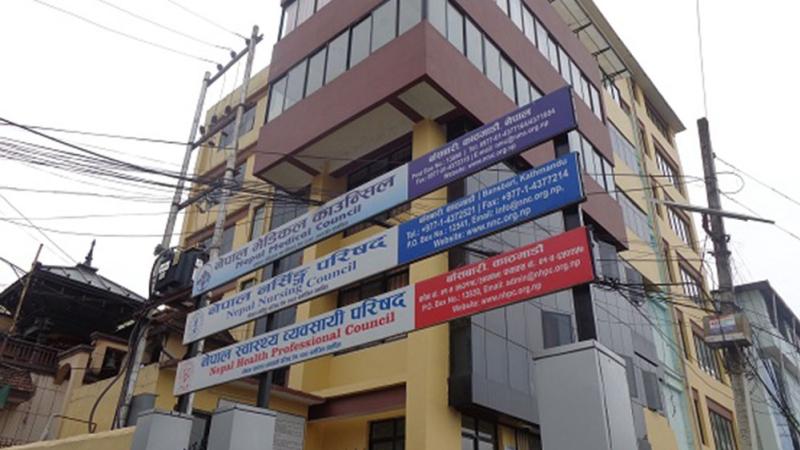
Feb 21, Kathmandu - The Nepal Health Professionals Council (NHPC) has released the results of its 17th licensing examination, shedding light on a stark reality within the health education sector. While the overall pass percentage stands at 67.31%, alarming data shows that in 12 technical subjects, not a single student has passed, with results declared as zero (null).
The failure of even postgraduate candidates to pass in certain specialized fields raises serious concerns about the quality of education at related institutions and questions the competency of graduating students.
Subjects with Zero Passes:
According to data provided by the council, no candidates passed in the following fields across various levels:
Postgraduate (Master’s Degree):
- Master in Optometry (6 candidates, all failed)
- Master in Physiotherapy (Cardio-Pulmonary) (1 candidate, failed)
- Master in Physiotherapy (Health Promotion & Rehabilitation) (1 candidate, failed)
- MSc in Medical/Clinical Biochemistry (4 candidates, all failed)
- Master of Science in Medical Imaging Technology (1 candidate, failed)
Bachelor’s Degree:
- BSc Renal Dialysis Technology (3 candidates, all failed)
- Bachelor of Homoeopathic Medicine & Surgery (BHMS) (2 candidates, all failed)
- BSc Cardiac Technology (2 candidates, all failed)
- BSc Medical/Clinical Biochemistry (3 candidates, all failed)
- BSc Medical/Clinical Microbiology (1 candidate, failed)
Certificate Level (PCL):
- PCL in Acupuncture, Acupressure & Maxillofacial (1 candidate, failed)
- PCL in Yoga & Naturopathy (4 candidates, all failed)
Exam Statistics:
The council conducted the examination across 15 shifts with a total of 4,470 candidates. Of these, 3,009 candidates (67.31%) passed.
Breakdown by level:
- Postgraduate: 56 candidates participated, with 25 passing (44.64%)
- Bachelor’s: 724 candidates participated, with 429 passing (59.25%)
- Certificate: 3,690 candidates participated, with 2,555 passing (69.24%)
The results have sparked debates on the quality of health education and the need for immediate reforms to ensure competent healthcare professionals in Nepal.










 Indian Rupee
 U.S. Dollar
 European Euro
 UK Pound Sterling
 Swiss Franc
 Australian Dollar
 Canadian Dollar
 Singapore Dollar
 Japanese Yen
 Chinese Yuan
 Saudi Arabian Riyal
 Qatari Riyal
 Thai Baht
 UAE Dirham
 Malaysian Ringgit
 South Korean Won
 Swedish Kroner
 Danish Kroner
 Hong Kong Dollar
 Kuwaity Dinar
 Bahrain Dinar